Showing posts with label Gaming - System: Nintendo DS. Show all posts

Monday, August 18, 2008

Review - Speed Racer


Developer/Publisher: Virtuos Ltd. / Warner Bros. Interactive Entertainment
Release Date: May 6, 2008
Rating: Everyone – Mild Cartoon Violence
Available On: PS2 ; Wii ; Nintendo DS
Genre: Racing
Number of Players : 1 player; 2-6 (local multi-card)
Strong Points: Fast racer with a stable framerate; good controls; graphics are done well for the DS; unlockables; enjoyable trick and stunt system
Weak Points: Not that much replay value, underwhelming presentation outside of racing; no online play; no story mode
Technical Score: C+
Artistic Score: B
Final Score (not an average): B-
Moral Warnings: Art for some female drivers accentuates cleavage; you can attack other racers with your car

When it comes to movie tie-in games, most gamers would agree that the majority of them are bad. Many would feel rushed, unpolished, use clunky controls and would be a waste of our cash. I was surprised to learn that Speed Racer was a game that doesn’t follow that pattern.

Speed Racer: The Videogame takes place one year after the movie. And that’s about as much story as you’ll get. The main gameplay consists of completing the World Racing League mode in varying difficulties to unlock further modes. The WRL mode allows you to win cups that grant you fans that go towards unlockable content. When completing cups, you will also unlock several game modes (time trial, Car-Fu, and Stunt-Combat) that you can play in Arcade and multiplayer mode once unlocked. Many of the racers you saw in the movie are back, albeit in cartoon form. Every racer has stats that affect their performance, like handling, speed, acceleration, etc. They all feel unique and balanced. I switched back and forth between three of them, and I didn’t feel outclassed if I didn’t get the fastest car.

The WRL mode pits you against other racers in a futuristic setting, something akin to Wipeout or F-Zero. All the tracks have splitting paths, sometimes many, are loaded with half-pipes to trick off of, and there’s a nice mix of corkscrews, vertical loops, and massive jumps. There are no weapons in the game other than your vehicle. When in range of other racers, a B icon appears and when the button is pressed, you initiate Car-Fu. Like the movie, your car springs into the air and you are required to input either an X or a Y in a timed event to make a successful attack. If you are too slow or fast, the attack will fail, leaving you worse off than before. But if you time it right, your opponent spins out and you speed away with more turbo. Tricks, stunts, and successful Car-Fu attacks all add to your turbo gauge. When you reach 90% or more of that gauge, you can enter “The Zone” and your vehicle is automatically guided down the track accompanied by blue tunnel vision. Racers in your way are knocked away, filling your gauge more. If you have used the Bullet Bill in Mario Kart DS, you’ll get the idea. It’s quite a thrill to plow into enemy cars in a short span, thrusting you to first place on the last lap before your turbo runs out.

Stunts come in the form of flips, spins, and drifting. When speeding along, you can press the jump button and hold any direction to flip, scoring some points (which count towards unlockables), all while looking good. Drifting around tight corners grant you points and turbo as well. After a good amount spinning and flips in the air, you can get even more points by landing correctly. You can land perfectly on all fours, on two, or even one, which is always enjoyable. If you botch your landing though, you’ll spin out and get nil.

So you may be saying that all sounds fun… now how is it on the eyes? When racing, the graphics rock. It has a great cel-shaded look, bright colors, and stylized effects all at blazing speeds. I was surprised the game didn’t chug along with all the detail that was flying past when racing. Expect detailed night time cityscapes, a jungle complete with waterfalls and volcano, and vibrant deserts all at a good clip. Outside of racing, it was underwhelming. The menus felt stale and uninspired. Even some of the racers from the movie look different in-game. With the level of detail when speeding over 350MPH though, it’s a small complaint.


The sound in Speed Racer is average. It has good vehicle sounds like screeching tires and the appropriate sound when tricking and using the turbo, but the music is drowned out. When I changed the sound levels, the music seemed rather poor. I would’ve liked there to be some kind voice over for the drivers or better sound tracks, but the overall package is adequate.

There is no online multiplayer, which I believe would’ve been a great addition. There is local multi-card play for 2-6 people though, but I had no one to race so I can’t comment much on that. Single-card play would’ve been another great addition, but it was passed up for whatever reason. The Arcade mode is there for those with little time to play, but it still gives you the same amount of speed on the same great tracks like the WRL mode.

One thing I should mention about the moral content would be that some of the female racer profiles show cleavage and accentuate that with large breasts. Besides that and the mild car combat, there is nothing else that needs mentioning.

At the end of the day, Speed Racer is a good effort that racing fans should consider picking up for the DS. It runs at a great frame rate, the racing is solid, the AI is good, albeit with some rubber banding, and it’s never sluggish. There are no obstacles to slow you down, no frustrating Blue Shells that will stop you from getting first (yes, I’m looking at you, Mario Kart) and everything feels streamlined. It’s good fun when you get that racing itch, but don’t expect a lot of depth when you give this game a spin.

-Jonathan Andrews (jonathan@revolve21.com)

Read full article

Monday, July 14, 2008

Review - Kirby Squeak Squad


Developer/Publisher: Flaghsip / Nintendo, HAL Laboratory
Release Date: December 4, 2006
Rating: Everyone – Mild Cartoon Violence
Available On: Nintendo DS
Genre: Action-Adventure
Number of Players: 1 player; 2-4 players (local single-card)
Strong Points: Colorful and clean presentation; music is fairly strong; different graphic and combat options; tons of unlockable goodies; fun to play; decent puzzles
Weak Points: Game is short in length; not that challenging; some abilities feel useless; mini-games get dull quickly; combat is simple
Technical Score: B
Artistic Score: A
Final Score (not an average): B-
Content Warnings: Cartoony violence; a magician boss; ghost ability that allows you to possess enemies; an earlier boss transforms into a darker version of himself due to the ending boss's power


Kirby's previous outing on the DS had him rolling through levels as a ball in Kirby Canvas Curse. Utilizing touch controls only, the game was praised for being original and fun. His second outing on the DS comes in the form of Kirby Squeak Squad. The game goes back to its GBA roots as a pure platformer, so the stylus is not relied on as heavily as it was in KCC, but is still needed for some gameplay elements. The small puff of pink this time around comes with new abilities to dispatch foes with, multiplayer modes, and a new story mode to romp through.

The game opens with Kirby beginning to dine on delectable strawberry shortcake, but the dessert is stolen from him before he could enjoy it by some unknown bandit. Suspecting that it's the work of King Dedede (the main villain in a majority of previous Kirby titles), Kirby sets off to find his cake and the person who stole it. Soon it becomes clear that it wasn't the King that took it, but a band of mice called the Squeak Squad. Kirby begins to track down his shortcake all while collecting chests, inhaling food and enemies, and battling the Squeak Squad.

If you're new to Kirby, then the formula goes something like this: Kirby goes through a level to reach the exit, sometimes with multiple doors and puzzles. He can jump, crouch, float, and inhale objects. The objects include food, obstacles, and enemies. A majority of the enemies in the game have abilities that Kirby can absorb. If you see a foe with a sword, you can inhale him, press down on the D-pad, and acquire his ability (in this case, a sword). In Squeak Squad, you are able to hold up to five items in your stomach for later use, or you can combine them for a more potent effect. For example, you can inhale three normal enemies which show up as stars in your stomach. Using the stylus, you can combine the three stars for a big one that will do plenty of damage when launched at a foe. You can click on the icon of what you swallowed to use it. If you have a fireball icon in your stomach and you tap on it, you now will have the fire ability. Some abilities can combine together to become a more potent form. One would be adding Shock and Sword together; this will give your blade the ability to cause elemental damage and send out shockwaves that damage enemies slightly. There aren't a lot of ability combinations, but the ones that are there are decent. You can also combine food together to heal Kirby for more than you would when eating them by themselves. You are also allowed to combine 3 mini-Kirbies for a 1UP, but there aren't a lot of the mini-Kirbies to collect in the game.

There’s a story mode, three mini-games (which can be shared from a single cartridge across multiple DS systems), a boss endurance trial, a time trial mode, and a gallery where you can see everything you've unlocked. One timed mini-game has you tapping a certain food before the enemy Squeak does, but if you tap a bomb, you lose health. Another has you dragging the stylus into other enemies in a top-down perspective, the aim being to knock other star-rides off a platform. The story lasts anywhere from four to six hours depending on your play style and if you unlocked everything. The mini-games, while a decent distraction, aren’t that fun. The gallery will allow you to play music, go over art from the game, and show you what kind of odd trinkets you collected.

When playing the levels, you will run across chests, usually three in a level. Many times you have to use a certain ability to reach the chests or to clear a way to them. When you come along the single special chest in a level, you have to race a boss Squeak Squad member to get it. This can lead to some frantic moments when playing, but if you miss it, you can always revisit the level. If Squeak Squad members take a chest, you have a small window of opportunity to go inside their hideout, defeat them, and run to the exit with the chest. To get a complete 100% rating you must collect all the chests. Inside these chests are usually unlockables like pictures, skin colors, music, food, and ability scrolls (which add a passive benefit). One fun part of the game was figuring which ability to use to reach a chest, or narrowly escaping a boss with a chest.

The first thing that stood out when playing the game was the presentation. The colors are rich and crisp, the backgrounds change and move with Kirby, and the animation is smooth. The game is in 2D, but the cartoony look fits the character well. You are able to customize Kirby's color (once unlocked), so if you get bored of the pink hero, you can change him to lime green or even a black version. The health bar's icon will change to match the color as does the outfit Kirby wears when he has an ability. And though it's not a big change, it's a welcome one to this reviewer. The levels are standard themes like lava, snow, and space. I would’ve liked more variety, but what’s there still looks good.

The different abilities also change how Kirby looks and what he wears. The sword ability gives Kirby a green cap and large sword that resembles the Legend of Zelda games while the magician ability gives Kirby a large top hat that could easily cover his whole body. Some even change his body like the UFO and Wheel ability. The only problem with the different abilities (twenty-five in total) is the fact that some skills will rarely be used, and most enemies only use a certain amount of those abilities. There is a secret level that can be unlocked which allows you to pick up any of the abilities, so that's a good option if you don't feel like running through a level just to get a favorite ability.

The music is strong throughout and can be played at the menu when unlocked in-game. There was only one water level where the music was unbearable, but outside of that song, it has its good pieces. The sound effects get the job done, but nothing really stood out. There are sounds for all of Kirby’s actions, even falling face first into the ground from a high height only to rebound on his feet, smiling. The music helps pace the game and will get you rushing for that last chest when you see a boss race for it as well.

There isn’t much in the way for moral hang-ups when playing this game. There is an unlockable ghost ability that allows you to possess enemies for a time, but besides looking cute, you have the option not to use it. A boss is also changed into a darker version of himself, though it doesn’t have any type of occultic elements associated with it. There is a magician Squeak Squad boss, and he does use a wand, but that’s about as bad as the game gets.

I enjoyed playing Kirby Squeak Squad, even if was a breeze to play through. It was charming for the five or so hours it took to complete it, and I would easily recommend it for purchase if you have a young child or sibling, or if you’re a Kirby fan. For a game geared towards the younger crowd, I can’t complain much. With good production values, unlockables, and a candy-coated exterior, it’s a sweet treat best had every now and then.

-Jonathan Andrews (jonathan@revolve21.com)

Read full article

Friday, July 11, 2008

Review - Guitar Hero: On Tour

Developer/Publisher: Vicarious Visions / RedOctane/Activision
Release Date: June 22nd, 2008
Rating: Everyone 10+ - Lyrics
Available On: Nintendo DS
Genre: Music
Number of Players: 1-2 (multiple cartridge, local wireless)
Strong Points: Gameplay is Guitar Hero on the go; pretty graphics; decent setlist
Weak Points: Setlist is only 26 songs deep; some songs don't translate to Guitar Hero that well; control system can be difficult and cause cramps due to its size and form
Technical Score: B
Artistic Score: C+
Final Score (not an average): C-
Moral Warnings: Some characters are immodestly dressed; some lyrics contain profanity, sexual allusions/references, and drug references


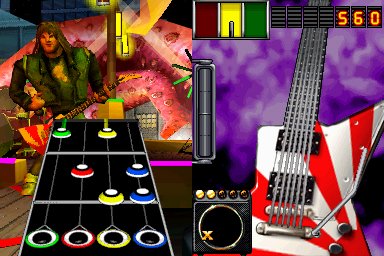
For the unaware, Guitar Hero has been challenging gamers and non-gamers alike to pick up a simplified version of an electric guitar and strum along with hits of the last few decades. The formula is simple: hit the right buttons at the right time (portrayed by buttons coming towards the player) and strum in time with the music. The execution is surprisingly addictive, and the multiplayer aspects of the series have practically made it a household name.

With incarnations of the series on the Playstation 2, Playstation 3, Xbox 360 and Wii, Activision decided that it was time to expand its reach into handheld gaming territory. In many respects, the transition from a guitar peripheral and the big screen to a palm-sized controller and the small screen is made with surprising success.

This is due, in no small part, to the fingerboard attachment that comes with the game. This board offers four buttons (instead of the original five of the game's older siblings) and plugs into GBA cartridge slot of the DS Lite (or into the original DS with an included adapter).


Of course, this fingerboard adapter is also the game's biggest downfall. It's true that it gives a somewhat similar feel to the console controllers, but, in execution, it simply doesn't work as well. The first problem is that the buttons are too small, and placed too close together, to be functional for anyone with remotely large hands. Worse yet, the nature of the controller (and the somewhat awkward way of having to hold it) has a tendency to cause hand cramping in a short amount of time. Adding insult to injury, the strap that is part of the attachment tends to be too loose to work right or tight enough to make finger movements a challenge.

These complaints, serious as they are, could be overlooked if the attachment were easy to use, but it really isn't. The song difficulties, even on Expert, are much simpler than what was seen in the console games. Still, maintaining note streaks (and, in some cases, even completing songs) is very challenging due to the controls. Indeed, the game's challenge comes much more from the controls than the songs themselves. This is not the case with the console games.

Not all is terrible with the controls on the DS, however. As mentioned in our preview of the game, strumming with the touch screen is much more natural and fluid (for guitarists, especially) than the clicking of the strum bar on the console peripherals is. Activating the score multiplier, Star Power, is also very simple with the touch screen. Use of the "whammy bar" is intuitive, too.

Beyond the controls, the game very much plays like its older siblings. The main game progresses by picking a character to play as and proceeding to show mastery over songs that pick up difficulty in a fairly gradual way. Four levels of difficulty (each with increasingly complex fingerings) are present. Shooting for high scores by minimizing the number of notes missed is a major part of the game's replay factor.

Which is a good thing because the game's song list only has 26 tracks. That may sound decent, but, at three-to-four minutes a song, that's only two hours of gameplay if played in one sitting. That setlist is less than half the length of the other games in the series. Then again, considering that this is a DS game, there isn't a great deal of room for complaining (due to the technical limitations of the media).

The setlist, while not the best ever, is very solid. With a decent variety of genres and eras, there's a little bit of a lot of sounds. If not for the control issues, many of the songs would be a lot of fun to play. What is actually impressive is how good the songs sound through the DS hardware. Most of the tracks were made using original master tracks from the actual band recordings, which is nice in itself. Still, the overall sound quality is very good.


Graphically, the game is also fairly pretty. The crowd is very simplified, and the venues themselves are not really phenomenal, but the character models are surprisingly smooth and detailed for the DS hardware. The guitar images, including the scrolling fretboards, capture the look and feel of the other games in the series pretty well, too. The special effects (few as they are) also help the transition to the handheld.

Morally, the gameplay itself presents little to be concerned with. However, most of the female characters could use a little more clothing; one of the male characters wears no shirt. The only other real concern is in the realm of the lyrics. "Are You Gonna Be My Girl" laments that a girl "was with another man." "Black Magic Woman" uses light magical terminology to describe being in love. "Helicopter" includes a usage of "b------." "I Don't Wanna Stop" refers to drug usage, distaste for religion, and it mentions masturbation. "I Am Not Your Gameboy" contains a lyric that has sexual implications. "Jessie's Girl" revolves around a guy wanting his friend's girlfriend for himself. "Knock Me Down" refers to being high. "La Grange" alludes to bar-going. "This Love" refers to being high, and is very sexual in nature.

In the end, Guitar Hero: On Tour is an example of missed potential. On paper, everything lines up for On Tour to thoroughly impress handheld gamers. It looks pretty, it sounds good, and it even includes a guitar attachment. In execution, the game flops due to the awkwardness of the attachment (and the undue difficulty it brings to the table). For those with small hands (or extreme dexterity and/or patience), the game is exactly what it looks like: Guitar Hero on the go. The only problem is that it just isn't really Guitar Hero.

-Kenny Yeager (kenny@revolve21.com)

Read full article