Showing posts with label Gaming - Genre: Action. Show all posts

Friday, April 3, 2009

Review - God of War: Chains of Olympus


Developer/Publisher: Ready at Dawn Studios / Sony Computer Entertainment
Release Date: March 4, 2008
Rating: M for Blood and Gore, Intense Violence, Nudity and Sexual Content
Available On: Sony PSP
Genre: Action-Adventure
Number of Players: 1
Strong Points: Outstanding music and visuals; engaging combat; upgradeable weapon options; unlockables for further play-through
Weak Points: Short, only taking about 7 hours to complete; enemies repeat a lot; some control issues; story wasn’t satisfying
Technical Score: B+
Artistic Score: A-
Final Score (not an average): A-
Moral Warnings: Blood and gore is a big part of combat (blood sprays and enemies lose limbs); brutal violence (includes graphic executions); Mythology elements presented in the game (Hades, gods and goddesses, etc.); magic is used to some extent; exposed breasts are shown; there’s an optional sex mini-game as well


God of War: Chains of Olympus follows Kratos, a great Spartan warrior indebted to the gods. At the start of the game, he is tasked to defend Attica from the invading Persian army. He obeys and after cutting through the soldiers and successfully taking down a basilisk, Kratos notices the sun plummeting from the sky to the earth and sets off for it. So begins the game proper as Kratos is drawn to the aid of the Olympian gods once again.

The game is a prequel to the PS2’s God of War, so if you didn’t play that one, you’ll be fairly lost as to Kratos’ background since neither the manual nor the game expounds too much on him. While the story does involve strong voice acting and good looking cut scenes, it really didn’t tie up the loose ends and just left more questions. For those new to the series, it wasn’t that satisfying as a story, but I’m sure the fans of the PS2 iterations will get a lot more out of it.

Gameplay, on the other hand, is a much stronger experience. Combat for most of the game involves using your Blades of Chaos (swords chained to Kratos) in various weak and strong attacks to pull off combos. At first you’re given just basic chains to pull off, but as you progress you’re given stronger chain attacks, some able to clear entire rooms in seconds. Attack chains further in the story could begin with multiple area swipes into a focused explosive strike to break armor, and then you take that foe into the air, spin your metal chains around like a helicopter blade, throw out a chain to bring the helpless guy back to you, and then kick him back into the ground. That last sentence would only take about four seconds to pull off. You can also grab enemies, block, dodge, and counterattack through parrying, but these movements can be unresponsive sometimes.


Killing enemies and getting a higher combo-count will reward you with red orbs that go towards magic and weapon upgrades. Along with your various chain attacks, you’re given magic attacks throughout the game. The magic isn't as useful as pure melee, but it can get you out of some rough spots. Bigger enemies near defeat will have a button icon over them that, when pressed, Kratos will perform a special finisher (like kicking a blade into a cyclops’ eye) that will kill off that foe and reward you with various orbs. Finishing enemies with low health reward even more orbs (and in some cases, orbs to replenish health and magic) than killing the enemy with your average attacks. This is very useful when you’re facing off against the more deadly creatures further on.

Overall, the combat in Chains of Olympus will keep you on your toes and will cause player deaths many times over. The game ramps up the difficulty as you progress and enemies will even use attacks that require you to mash the shoulder buttons or break from grapples. Failing to do so will cause the next hit to instant kill you. If anything, I should mention that smaller enemies sit back and wait to attack. Quick time events with the analog stick are fairly tricky to pull off, but combat is a satisfying and visceral experience aside from that.

When not ripping the wings off a harpy or laying waste to armored skeletons, there are various puzzle elements for Kratos to overcome. This could be anything from run of the mill "put this here and turn this" to setting up statues to reflect into a central point. There are some clever puzzles to be had, but most objects that need to be interacted with will flash, making most of the puzzles easy. You will also come along chests that will either give you health and magic orbs before tough fights or give you items that will increase your max health and magic (once you collect 5 of each that is). Platforming is used to some extent, from scaling walls to swimming to cranking a massive gear to progress further into a level.

There are plenty of things for Kratos to do in each environment and keeps the game fresh since you’re just not running from point A to B all the time. As with the combat, quick time events are still a big part of the game, so you’ll be mashing the circle button to open chests and doors, move blocks, and so on. After completing the game, there’s a challenge mode to play and depending on which mode you beat the game on, you can unlock silly skins for Kratos, or even various Making Of movies from the developers. Chains of Olympus will only clock in about 7 hours on normal difficulty, but I believe it offers enough replayability for another one or two play-throughs.


If anything binds this game together nicely, it’s the presentation. The visuals closely resemble the PS2 game. With all of the various lighting and special effects running, it’s impressive that the game runs as smoothly as it does. The camera work will give you plenty of panoramas showing large draw distances and will pull back a few times, showing how insignificant Kratos really is compared to these massive environments. The cutscenes are a variation of CGI with an almost comic-book look, and the game engine rendered videos are just as well done. Most enemies are of low polygon count though, and are ugly compared to Kratos and the other characters in the game. It’s not a big problem since the game is drawing many of them, but it did bother me some. The music hits all the right notes as well, bringing the diverse areas to life and being distinct enough from each other to not sound thrown together. The voice actors bring some fine performances to the characters, and the combat sounds downright brutal, from the sound of flesh being sliced to the snapping of necks.

As for the moral content in the game, it easily earns it’s M-rating. Combat in the game is very bloody and enemies will split apart, be dismembered, beheaded, and so on. Blood sprays and spurts a lot, and the Hades level has rivers full of blood flowing past in the background. The way you dispatch foes is brutally violent as you can finish them by snapping their necks, kicking blades into them, ripping them in two, ripping heads off, crushing them, burning them, and other brutal means. The game mentions and takes place in Greek mythology, so you’ll see and talk to gods and demigods, and you'll face off against minotaur, harpies, skeletons, cyclops, and more. There’s a Hades level with flowing blood for rivers and Tartarus, where people are chained to the wall and are able to be killed for orbs. Magic is used by Kratos; one of the attacks summons Efreet to burn enemies. Breasts are shown in the game, once in a long cutscene, some in Tarturus from the prisoners, and on statues. There’s also a sex mini-game present which uses the quick time events and shows two women on each other with breast showing. The mini-game is optional, and doesn’t show sex on-screen, but you still hear heavy moaning and see a nearby candle shaking.

If you’re looking for an epic action game for the PSP, this is it. It is on the short side, but it’s an enjoyable ride to the end. While I didn’t particularly care for the story, it’s still grand in scope, and will be fun even if this is your first God of War game. With slick combat, great visuals, and virtually no load times after it first boots up, the developers at Ready at Dawn have given a great example of portable gaming done right. But those not fans of over-the-top bloody violence or the other moral subject matter should definitely sit this one out.

-Jonathan Andrews (jonathan@revolve21.com)

Read full article

Saturday, February 21, 2009

Review - Star Wars: The Force Unleashed (Wii)


Developer/Publisher: Krome Studios/LucasArts
Release Date: September 16, 2008
ESRB Rating: Teen (Violence)
Available On: Wii (version reviewed), DS, Playstation 2, Playstation 3, PSP, Xbox 360
Genre: Action RPG
Number of Players: 1-2 (local competitive)
Strong Points: Very fun gameplay; good use of motion controls; strong use of Star Wars license
Weak Points: Generally subpar graphics; repetitive, linear gameplay
Technical Score: C+
Artistic Score: C+
Final Score (not an average): B
Moral Warnings: Game revolves around hack and slash violence (no gore) along with some more creative means of destruction via the Force; the Force is a vague supernatural notion; immodest attire on some female characters


The Force Unleashed was a long time coming when it finally hit store shelves. Many people got hyped about the physics engine that LucasArts had been pushing with detailed destructible environments, but my guess is that it was simply the Star Wars name that resulted in so much hype. Whatever the reason for it, The Force Unleashed came with very high demands. What we ended up getting is a very fun but rather shallow experience that didn't meet all of those demands, but still offers enough redeeming qualities to warrant a rental or purchase from the discount rack. Now that I've gotten rid of the suspense surrounding my final take on the game, let's actually take a look at where the Force is strong with this one.

First things first, though. In case you missed it in the header, this is a review of the Wii version of the game. There are many ways in which it is similar to other versions of the game, but be careful of using this review as a primary source of information if you are interested in one of the other releases. Trying this again, shall we get down to business?


When the game opens up with sounds and music straight out of Star Wars, you will begin to anticipate a genuine Star Wars experience. When the opening sequence of the game begins with Darth Vader arriving on the Wookie planet of Kashyyyk, you know beyond doubt that this is truly Star Wars. If there's one thing that The Force Unleashed does well, it's capturing the atmosphere and spirit of the films.

As the plot unfolds, we play the part of Vader's secret apprentice, Galen Marek. The story takes place in the time between Episode III and IV. Since I hate spoilers just as much as the next person, I won't be detailing much of the plot. However, the story does a good job of filling in some of the gaps between those films. For the most part, the characters and character interaction are fairly solid and interesting. In all reality, the biggest letdown in regards to the story is that there are a couple of elements that are iffy when it comes to Star Wars canon. In fact, one of the endings completely throws canon out the window. Then again, only well-informed Star Wars fans are likely to pick up on these things., and the bulk of the story is still a worthy addition to Star Wars canon.

On the other hand, The Force Unleashed is first and foremost an action game, and these few issues with the story progression carry little weight with them in regards to actually playing the game. Fortunately, first and foremost, the game is a ton of fun to play. Yes, you pretty much do the same things over and over, but the things you do carry enough thrill - and cool - factor with them that the repetitive nature of the combat can be overlooked for at least long enough to play through the story mode.

Again, I should point out that I'm talking about the Wii version of the game here, as that greatly affects the gameplay. The game really is about unleashing the Force. You can do this in all kinds of ways. From the simple yet effective Force Push to the wide-area Force Lightning and a host of other attacks, the game's tools of destruction are pretty diverse. More importantly, Wii control actually makes them even more fun to use. A quick thrust of the Nunchuck results in Force Push. Angled slashing with Wiimote results in similarly angled saber strikes.


Far and away, one of the most enjoyable techniques in the game is a combination of Force Grip and Lightsaber Throw; it's also one of the most brutal techniques available. Using a common enough grip move, you can hold a foe in place. Once your foe is suspended in the air, forcefully swinging your Wiimote results in throwing the lightsaber, sticking it in the suspended foe. However, this is just one example of the ways you can use and combine Force powers and lightsaber skills for maximum damage.

Though the clear emphasis in the game is on the actual combat, there are some minor RPG elements added for good measure. Fallen enemies gives you points that can be used at any time in the game menu to improve the potency of Force techniques and gain new ones altogether. Getting more powerful Force tools isn't altogether necessary to progress in the game, but having them builds on the cool-factor. As a result, the skill leveling system is mostly in effect to get you to destroy everything in sight.

On another note, the straightforward hack, slash, and Force Push gameplay is broken up with boss fights from time to time. Boss fights do make heavy use of the core engine, but there is a clear shift from emphasis on overwhelming force in favor of a more tactical approach. There are also occasional duel moments in which you'll lock blades with a foe. In these cases, you must align your Nunchuck or Wiimote with the angle shown on the screen and physically push forward. Additionally, timed-sequence moments take place during boss fights. Though these timed-sequences are a simple matter of moving the Nunchuck or Wiimote (whichever is shown on screen), it's actually quite possible to move the wrong one if you start to hurry.

Still, there is the matter of the repetitive gameplay. Playing through the story is a fairly short experience of 6-7 hours. For that duration, the simple formula of running from the beginning to the end of a mission killing anything that stands in your way stays entertaining. Whether or not it holds up long after that is very dependent on how much you enjoy the game's action. There are a few things hidden throughout the levels (concept art for the gallery, lightsaber color crystals) to encourage replaying the game. However, annoyingly, there is no mission select option; if you want to go back and play the third level, you will have to start your game over from the beginning.


Exclusive to the Wii version is a duel mode. The duel mode allows you and a local friend to choose from a host of Star Wars characters (some from the game, some from the films), select a map, and duke it out. The camera is fixed in a stationary location during duels (with the exception of the quick-time event moments that show up from time to time). Essentially, the duel mode is a modified form of the boss fights. The same Force powers and techniques from the main game are carried over to duel mode, so very little should be unfamiliar. The thing is, while duel mode is a nice idea, the implementation simply isn't a lot of fun. The repetitive combat isn't terribly off-putting in the context of the main game, but it's a lot harder to overlook in duel mode. As a result, duel mode ends up being an occasional diversion at best.

Unfortunately, the game's shortcomings do not stop there. Not the least of these shortcomings is the graphical department. I wish I were just referring to a small issue here or there, but the reality is that the decent elements of the graphics are the exception to the rule. The character models in The Force Unleashed are undetailed and jagged. Add to this that the texture maps are equally lacking, and the result is, in a word, ugly. In the story-driven cutscenes, the lacking nature of the graphics is very obvious.

On the other hand, the pacing of the game's action actually does a good job of hiding these things. In all fairness, when playing at full pace, you may not even notice the lack of detail in the graphics. However, you will probably notice some of the special effects that are included in the game. Blur effects employed when using Force Push are actually impressive. Still, they do not compensate for an overall weak graphical effort.


Though not exactly a disappointment, the game's sound direction fails to impress. Yes, lightsabers sound like lightsabers. Yes, Stormtroopers sound like Stormtroopers. Yes, the all-memorable themes are here. Everything works, but there is still something left to be desired in the voice acting. It's not that the voice acting is terrible, it's that it sometimes comes off as flat and uninspired.

This generalization of being neither terrible nor altogether excellent carries over to most parts of the game, and the moral aspect is no exception to this. As you've no doubt figured out, The Force Unleashed gives heavy emphasis to violence. Throughout the course of the game, you can, and will, strike down countless hoards of enemies with the lightsaber. Use of the Force allows you to dispatch foes by remotely choking them to death, send them soaring off a cliff, crushing them with nearby objects, electrifying them with lightning, and reflecting their blaster fire. However, in spite of the strong emphasis on violence, the quantity-over-quality approach manages to leave you feeling a bit distanced from the violence. The issue of annihilating masses of foes (human and alien alike) to keep Vader's order of leaving no witnesses plays little bearing on the gameplay (since you don't actually have to kill everything), but it is there in concept. Beyond the violence is the possible point of concern that is the Force. As with the films, the Force is presented as a morally neutral supernatural force that can be used to assist a wielder in a variety of ways such as telekinetically moving objects as well as sensing things in the future. Though I do not recall any profanities, it is not unheard of for the Star Wars games to include a few uses of "damn" or "hell." Sexuality is generally minor. Clothing (or lack thereof) on some of the female characters is the biggest issue in this department. Your ship's pilot, Juno, along with some of the female bounty hunters you will fight, wear cleavage-revealing attire. Lastly, two female boss characters wear little more than a bikini.

When all is said and done, The Force Unleashed really isn't worthy of any awards for greatness. If I were to make use of a list of the strengths and weaknesses for the game, it probably wouldn't fare that well on paper. With that in mind, I won't be calling it something it isn't. However, such a checklist would misrepresent the game. The reality is that it is a great deal of fun for at least a complete play-through. It is repetitive, but it manages to carry enough appeal and fun with it that the repetitive nature is easy enough to forget about for a while. Also to the game's credit, even though the Star Wars geek in me wants to cry foul at the slightest hint of breaking canon, it really does do the license justice. The game won't last forever, but if you won't be put off by its constant violence or some of its mediocre technical qualities, I wouldn't hesitate to recommend that you rent it or even purchase it if you can find a good discount.

-Kenny Yeager (kenny@revolve21.com)

Read full article

Friday, February 13, 2009

Review - Marvel Ultimate Alliance


Developer/Publisher: Raven Software / Activision

Release Date: October 24 2006

ESRB Rating: Teen for Mild Language, Violence

Available On: Xbox 360 (version reviewed), Playstation 3, PC, Wii, Playstation 2, Xbox, Playstation Portable

Genre: Action RPG

Number of Players: 1-4 (local), 1-4 (online)
Strong Points: Strong co-op; large hero roster; 15-20 hour main story; unlockables and extra content; engaging combat; unique locales

Weak Points: Repetitive; technical bugs; camera issues; skill and hero imbalances; brain dead puzzles

Technical Score: C+

Artistic Score: B

Final Score (not an average): B-

Moral Warnings: Mild violence; hell-themed level with demons and pentagrams, includes devil-esque bosses; revealing costumes; supernatural characters and levels; minor curse words


Marvel Ultimate Alliance begins with a bang as Nick Fury sends out a distress call to any and all available heroes. It just so happens Wolverine, Spider-Man, Thor and Captain America were in the neighborhood. You arrive on S.H.I.E.L.D.'s Helicarrier which is seemingly under attack by a group of villains known as the Masters Of Evil, led by Dr. Doom himself. After fending off the assault, Nick Fury asks you to track down Doom and his remaining cohorts, find out what he's up too, and stop him for good. This eventually leads you to Atlantis, Asgard and beyond. Along your journey, you'll speak to many characters from the Marvel universe, some well known, and others that are just there for the die-hard fans. And for the true comic book geeks, there's plenty of story and dialogue to sink your teeth into.

For those who are new to the Action-RPG genre, the premise is simple: Fight your way through a level packed with various enemies, level up, get new abilities, collect gear, credits, and have fun while doing it. Before each level, you choose four heroes from a roster of over twenty five (more can be unlocked during gameplay). As you complete objectives and beat the electronic pulp out of robots and other baddies, your characters level up. You get a skill point per level to add into your powers (more powers are unlocked as you reach certain levels) and credits dropped from enemies can go into either leveling up your costume bonuses (defense, max energy, health regeneration, etc.) or to even buying more skill points for that extra edge. As long as you have one point into a skill, you can mix and match the superpower attacks you want for free. For example, you can decrease 4 points from one skill and spread the points out to other skills, but still require one point in the skill at all times. Are your ranged attacks not working out too well? Put the points into a melee skill and watch the enemies soar into the next room with a single blow. There's plenty of options from the skills and costumes to fit your playstyle, whether it's a long-ranged beamer or a spandex-clad melee master. And while the system isn't all that deep for customization, it's nice to have the extra options. For those who would want to get to the smashing instead of fumbling over whether the +10% damage or +2 defense gear is worth it, the game includes options for automatic skill and gear distribution for you.


Combat is comprised of melee attacks mixed with a nice dose of power use. You have a weak and smash attack that can be chained for different combos, a grab move that allows you to whittle away enemies by tapping the weak attack once you have them in your grasp and then use your smash attack to launch them away or bring other special effects (like stuns, knockback, knockdowns) into play. Blocking and dodging is also available, but not really required unless playing in Hard mode. Health and energy are replenished through defeating baddies and breaking objects. Death is handled by requiring you to wait five minutes before the hero is revived at the nearest save point. Powers can be used by holding the right-trigger and then pressing any of the four face buttons on the controller. There's roughly eight abilities to choose from for each character: several varied attacks, area, ranged, melee, etc.; two boosts, team powers that bolster allies and weaken enemies; and an Xtreme attack, a power that unleashes the full might of your hero. You can switch powers out on the fly during gameplay by holding the right-trigger and pressing the d-pad, which is useful when you have multiple skills to choose from, but limited slots to put them in. To keep the combat fresh, some powers ask you to rapid-tap to fire multiple shots, like Spider-Man's Web Bullets; press and hold like Captain America's Shield Throw power, which admittedly is very fun to use; or even twirl the analog stick for Thor's engulfing twister. Even with the large amount of skills and characters to pick and choose from, several heroes, such as Blade and Elektra, are just not that much fun to play. There are skill imbalances as well, with some very weak attacks taking large amounts of energy, and on the other side of the coin are highly damaging skills that can easily be spammed for low cost. While there is still a strong selection of adequate heroes, more balancing across the board would have been a welcomed addition.

Levels are filled to the brim with crates, barrels, and enemies to smash through. And it's this chaotic mayhem that makes the game plenty of fun. But one thing that hinders the fun would be the puzzles. Many times you are required to solve a puzzle to open new paths or to free other characters to progress in the game. The puzzles are very lackluster and require no thought. Besides the puzzles, there are small rewards here and there for exploring. Stat powerups, comic book art, and more can be found when breaking through a secret wall. Each level is sprinkled with both minor and major boss battles. For instance in the Murderworld level, you’ll face off against Shocker and Rhino and for the finale you’ll attempt to take down a towering robot that can easily put some hurt on your team. The main boss battles are usually accompanied by quick time events that require you either to press the displayed button to dodge huge hand swipes or requires rapid tapping a button to impale a spear into a foe for instance. Fail these mini-games, and you get a nice chunk of health taken away. These events help break up the usual fighting while adding a sense of urgency, but aren't that much of a challenge.


The graphical detail in Ultimate Alliance looks very polished. Levels are detailed and environments vary from a mobile military platform to the waves of Atlantis to an alien city. Heroes look good when in battle, but can look down right ugly when under close inspection. The graphics do a good job of showing off each of the heroes' super powers, from Iron Man’s energy beams to Spider-Man's web action. If you snagged the 360-only DLC, Nightcrawler’s teleport smoke and Magneto’s magnetic waves look particularly top notch. It seems during heavy combat, though, that the powers can look down right ugly or not even play, most likely to keep the frame rate stable. Character animation is fluid and matches each hero's personality from the agile Spider-Man to the lumbering Thing. One outstanding part of the visuals would definitely be several of the CGI movies. It’s just too bad that there aren’t more of them.

One nagging issue to consider would be the camera. The camera will get blocked sometimes by the objects in the levels like doorways and will cover up the combat. The camera will sometimes make tall objects (like pillars) transparent, but this isn't always the case. It also makes many boss battles frustrating since you have to use both analog sticks to move your character and the camera, then use face buttons to attack. Shadows in the game can also get finicky when there are too many light sources around the characters.

As for the music, it has an epic feel with enough tracks for each level to not get repetitive. The voice acting is neither grand nor weak, but some performances, especially the villains, sound phoned in. Lines do repeat quite a bit, so hearing Spider-Man joke about “wanting to fight someone that doesn’t smell like old cheese” does get grating after the umpteenth time.


On the moral side, Ultimate Alliance has mild violence, but plenty of it. I say mild because it’s mainly punches and kicks, but there is a lot of super-power use that involves burning, freezing, throwing, blasting, etc.. Certain grab moves do look fatal, like Wolverine’s wherein he stabs a foe through the chest with his claws and then throws him away. It’s all bloodless, of course, and many of the enemies you face are either robots, supernatural, or alien in nature. Outside the combat, there’s minor language from some of the cameo characters (“damn”, “hell”, and the like). Some costume options are tight fitting or revealing for some women heroes, mainly Elektra. One main blemish would be the supernatural level called Mephisto’s Realm. A comic-book hell of sorts, the realm is an area with Pentagram puzzles, involves “Demonic Leapers” and “Demonic Souls," has screaming in the background audio and requires you to defeat two devilish bosses and a possessed hero. However, it’s relatively short compared with other game areas. As for other supernatural content, Ghost Rider and Blade are playable as is Dr. Strange who uses various mystical attacks. And I should mention that there is the whole mythology involving the Asgard levels, with mention of gods (Odin, Loki, etc.) and the magic involved there at Asgard and at Dr. Strange’s Sanctum that holds magical artifacts. There are several points in the story where you can choose to save someone from death or to let them die, too. As a whole though, only the hell level didn’t sit comfortably with me, but there wasn’t a lot else I found problematic, myself.

The game features up to four player co-op, both local and online (which didn't seem to have any lag during two hours of gaming). Playing with friends on your couch or over the internet gives you two modes to choose from: Cooperative and Arcade. The first allows you to play the game like you would in singleplayer, health and energy orbs are shared. Arcade, on the other hand, has you fighting your buddies over the orbs and the scoreboard. Who ever gets the final blow on an enemy gets more points, same for bosses. Points are tallied at the end of the level, and bragging rights go to the victor. Besides the main quest, there is also a trivia game for the comic-book gurus to dig through. Correct answers grants experience for the team. There are also collectible action figures that unlock characters that you can find during the game. Simulator discs also reveal some more detail about your heroes and relives some of the more memorable battles. Completing the discs with a high enough score grants stats bonuses and unlocks a custom for use. Additional endings will also occur depending on what side objectives you do, or don't do. Saving a computer mainframe for example will have an effect on the whole mutant population. Not saving it could even be worse for non-mutants.

Like superheroes, this game has its faults. While I would have liked to see more balance in the skills and a little more bug fixing, this game will still be a blast when you got a buddy saving the world with you. The story is long and ultimately satisfying, clocking in at about 20+ hours, even more on Hard Mode. The plethora of unlockables, trivia games, collectible items, secret characters and multiple mini-endings will warrant at least a second playthrough. If you’re a fan of button mashing, looking for a fun co-op game, or just want to see your favorite hero beat up hordes of wrong-doers in tights from the 70's (and I know there are many of you), here’s your chance.

-Jonathan Andrews (jonathan@revolve21.com)

Read full article

Friday, February 6, 2009

Metal Gear Solid 4


Developer/Publisher: Kojima Productions/Konami
Release Date: June 12, 2008
Rating: M
Available On: Sony Playstation 3
Genre: Stealth action
Number of Players: 1
Strong Points: Engrossing story; graphics, animation and sound are all as good as they come; superb stealth system; combat feels fluid and natural
Weak Points: A few of the cutscenes may be too long for some players, though they can be either paused or skipped
Technical Score: A
Artistic Score: A
Final Score (not an average): A
Moral Warnings: Violence is used throughout the game, with some blood; certain female characters show cleavage, and the camera also gives the option to zoom in on it; playboy magazines can be seen and looked through in the game, though no nudity is present; some strong language peppered throughout the campaign, including f- and s- words; Old Snakes smokes… a lot

Fans of the Metal Gear Solid series have been anticipating the fourth installment for quite a while now. Kojima Productions, the developer behind the fourth game in the series, has gone all out in polishing the game technically, trying to give it the most immersive experience seen yet in gaming. However, even with excellent graphics and superb playability, a game needs more to it than pretty explosions, resounding gunshots and good controls to make it something to remember; that is, the story, the most important aspect to any single player game, is necessary, and through much work and sweat, Kojima Productions manages not only to give the game a fantastic story (which, incidentally, manages to tie up all loose ends left dangling in previous games), but also gives it such a presentation that it will be remembered for generations to come.

The story of Metal Gear Solid 4 is actually quite simple to grasp. The game’s protagonist, Solid Snake, now codenamed Old Snake due to the premature aging occurring because his “clone” engineering is breaking down, is tasked with going into the Middle East and taking out Liquid, one of the game's main antagonists. Liquid is thought to be raising an army to take over the Sons of the Patriots organization. Sons of the Patriots, or SOP, is a nanomachine system used mainly by the PMCs to enforce the loyalty of their soldiers and to track them. The nano bots are injected into all soldiers, and can be used for many purposes, one of the most beneficial being silent talk. This lets soldiers of the same company talk and think as one, without so much as opening their mouths. If Liquid were to control Sons of the Patriots, he would have total control over anyone injected with the bots which would make him near unstoppable. Thus, Snake and company have reason enough to take him out. While I cannot say too much about the story without spoiling it, I will say that throughout this epic tale, you will come into contact with many old friends and foes previously seen in earlier Metal Gear Solid games.

Metal Gear Solid 4’s narrative, which in truth just boils down to having to take out the bad guy and save the world, has been seen elsewhere in other games of its ilk. However, the way in that it's told hasn’t been seen before. Truly the most amazing part to the game is the way that the narrative is told. It grabs hold of you and won’t let go until the very end, which, incidentally, is one of the most amazing moments in all of gaming. What makes it so unique is that the cutscenes, many of them ranging into the half hour-hour mark (they can be paused for breaks, though), are directed in such a way that they don’t feel like a game. When one of those epic scenes starts, it automatically feels like you’ve been put into a movie. One of the most notable reasons contributing to this effect would be the ‘flashbacks’ which occur during some of the movies. These flashbacks take place when you complete a certain button press (usually tap X repeatedly) that will appear in the upper left-hand corner of your screen. However, this also means you don’t want to put the controller down and relax completely during the movie scenes, because doing so may cause you to miss one of the prompted button presses, making you miss a flashback, which added quite a bit to the movie feel of the game.


However, this is also Metal Gear Solid 4’s biggest downfall: some of the movies may be too long for certain players. If you’re seeking an action story and nothing else, know that this game is probably not for you. Yet if story is irrelevant to you completely, the scenes can be skipped totally.

Metal Gear Solid games have always been about sneaking around behind enemy lines, avoiding detection at all costs, usually to retrieve a certain item or take out a certain person. Combat has never been the primary focus of the series, due mainly to tricky camera angles and buggy shooting controls. With Metal Gear Solid 4, that changes. Kojima Productions has tuned the combat so well that the game can, if desired, be played as a shooter. The aiming mechanics will feel familiar to anyone who has played Gears of War or the like, with L1 bringing up your weapon and R1 firing it. Or you could, if preferred, fight from the first person point of view. First person is triggered by holding L1 and clicking Triangle, and you’ll revert to the regular third person perspective once L1 is released. Those two control schemes open the game up to players wanting an action experience, whether as a shooter more as to the likes of Halo or third person action game similar to Gears of War.

Gun-and-duck cover taking is also a major aspect to the fighting, since Snake will take damage extremely quickly when in the open. You can take cover behind nearly any surface in the game, though some items will make better choices than others. For instance, you could jump behind the nearest fence when you begin to receive fire, yet bullets will pass through it if it isn’t thick enough. This has been seen before, yet in a game where every bullet you take could very likely mean the difference between life and death, it adds a considerable amount of strategy to the overall experience.

Early on in the campaign you will come across a weapons dealer named Drebin. Through him you will be able to purchase numerous weapons; you’ll find everything from a sniper rifle to a submachine gun to a rocket launcher in his shop. However, he doesn’t take money. What he takes is a special kind of points, called none other than Drebin points. These are collected in the field by picking up enemy guns. If the gun is already in your stock, it’s automatically sent to Drebin, minus the ammo, and you’ll be awarded precious Drebin points for your trouble. However, the points are good for more than just adding another gun to your inventory. Drebin will also supply you with explosives, ammo and weapon upgrades. And to add to the ease of use, Drebin’s shop can be accessed through the menu screen at any point in the game using the Mk. II, which will ferry items and weapons between you and Drebin.

If stealth is your preferred style of play, the game can still be played from that perspective, even with the large steps taken by the developer to bring in the action crowd. Old Snake has many gadgets which make sneaking about undetected in an enemy camp extremely fun. The OctoCamo suit is the most useful of them all. What this body armor does is blend Snake in with whatever the background. If you were to lie up against a white wall, your suit would automatically turn the exact shade of white as the wall. This works for any obstacle in an environment. The Face Camo, which you’ll discover a few hours into the game, is nearly identical in effect to the OctoCamo suit. It’s a mask that will blend into any background, making you even harder to detect.


Another asset to the stealth system is the Mk. II. This recon robot is used for exactly that: recon. Using its invisible cloak, you are able to sneak about quickly and avoid detection. The Mk. II can be used to stun enemies and pick up items, and it also serves as your contact between both Drebin and Otacon.

Graphically speaking, Metal Gear Solid 4 is one of the most beautiful games out there. The environments, to start off with, are gorgeous. The blades of grass and weeds will sway individually if a gust of wind should happen to disturb them, and they will crunch under foot or belly if Old Snake is crawling around within them. Smoke effects are another well done part of the graphics package. If a spray of machine gun fire runs along the ground, you’ll notice how the dust kicks up above the holes left by the bullets, and floats away, diminishing with longevity from the cloud it was to scant dust particles. However, even with how well done the environments are, they pale in comparison to the facial animations found in this game. Characters in Metal Gear Solid 4 portray emotions with such uncanny effect that you will likely think the faces on screen are that of real actors, and not computer generated images. It truly has to be seen to be believed.

Equal in class to the graphics is the audio quality in MGS4. The greatest reason for this is the voice acting, which is, honestly, Hollywood worthy. Snake sounds like a man in agony when he’s supposed too, and certain villains will likely creep players out with their eerie, albeit mechanical, voices (although the enemies in question are part robotic). Besides the exceptional voice acting, other sound effects, like gunshots and explosions, sound great, especially when paired with surround sound. Musically, Metal Gear Solid 4 has an extremely memorable score. It suits the game perfectly, adding even more emotional feeling where needed.

Morally, Metal Gear Solid 4 has several things hurting it. First off, and most notable, is the violence found within the game. The object of the game comes down to, in essence, having to kill the bad guys. However, the violence used is more like that found within a game like Call of Duty than that in, say, Gears of War. There is some blood, though it's kept mostly to cutscenes, and there is no gore to speak of. However, I can’t say the same for the language found throughout the campaign. Everything up to and including the f-word is used, though the worse of four letter words are infrequent, especially considering they namely appear in cutscenes. There is also some “potty humor” in Metal Gear Solid 4, though nothing explicitly “dirty”. For instance, at one point during a firefight, a friend of Snake's craps his pants, with complete sound effects and groaning. The “Suggestive Themes” rating on the back of the box refers to several things. The most chiefly noticeable reason for that rating would be the Playboy magazines that can be used to distract enemy soldiers, causing them to become totally oblivious to anything but the pages they are flipping through. Old Snake can also look through the magazines, though all the women in the magazines are in swimsuits; there is no nudity. That rating also refers to some suggestive comments made by certain characters, and the cleavage shown off by some of the female characters (which, during certain cutscenes, you are given the option to zoom in on). The last thing that should be mentioned in this section is Snake and company smoke frequently.

Metal Gear Solid 4: Guns of the Patriots is, without a doubt, a game that will be remembered for generations to come. Through its impressive graphics, amazing story presentation and epic characters, the game amazes in all areas. While some may be put off by the unusually long cutscenes, those numbers will be few; the game in between those story sequences more than makes up for having to sit through an hour long movie scene, compelling the player to proceed through the game by offering up amazing gameplay. So, if you own a PS3, there should be nothing stopping you from picking up this game today. It’s just that good.

Read full article

Friday, July 25, 2008

Review - Grand Theft Auto IV

Developer/Publisher: Rockstar North, Rockstar Games, Take-Two Interactive
Release Date: April 29, 2008 (Xbox 360, PS3)
Rating: Mature for intense violence, blood, strong language, strong sexual content, partial nudity, use of drugs and alcohol
Available On: Xbox 360, PS3
Genre: Action
Number of Players: 1-16 Players (online)
Strong Points: Most involving GTA story to date; addictive game play; lengthy play time
Weak Points: Some very unnecessary, mediocre parts; gun play, while a marked improvement, isn’t what it could be; some aspects of play vastly frustrating
Technical Score: A
Artistic Score: A+
Final Score (not an average): A-
Moral Warnings: Lots of violence throughout, though not all is graphic; player needs to pose as a gay man at one point; pervasive language throughout, including numerous uses of f— and motherf----, as well as lighter profanities and a character that uses c--t; corruption reigns throughout the city; sexual deviancy through prostitution possible, though not encouraged; player is able to visit strip clubs; player has the option to date and sleep with date, which can result in bonuses to player during game (i.e., a lawyer can remove a wanted level); moral dilemmas present themselves during course of game play, which can result in player killing an NPC in cold blood; revenge is presented as a positive during the final act of the game


In 2001, when Grand Theft Auto III launched, it was hailed far and wide as the first game truly exemplary of the then-next generation of video games. It hit among the first wave of games on the PS2, and sold millions of copies, as well as kick-starting a new genre: the sandbox game. There was a story, but that didn’t matter as much as the freedom to go anywhere and do anything within the constraints of the game. Within a year, developer DMA Design became Rockstar North and quickly developed the follow-up to GTA3, Vice City. If GTA3 was the innovator, then Vice City was certainly the game that refined the formula and added atmosphere, with a slick, pastel look that was obviously inspired by Miami Vice, as well as a soundtrack that was very relevant to the time. This atmosphere was continued in 2004 with a successor to Vice City titled San Andreas. That game proved that the developers could handle both social and cultural satire (which the series is not well-known for) as well as present a volatile time in history (Southern California in the early 1990s) in a mature fashion.

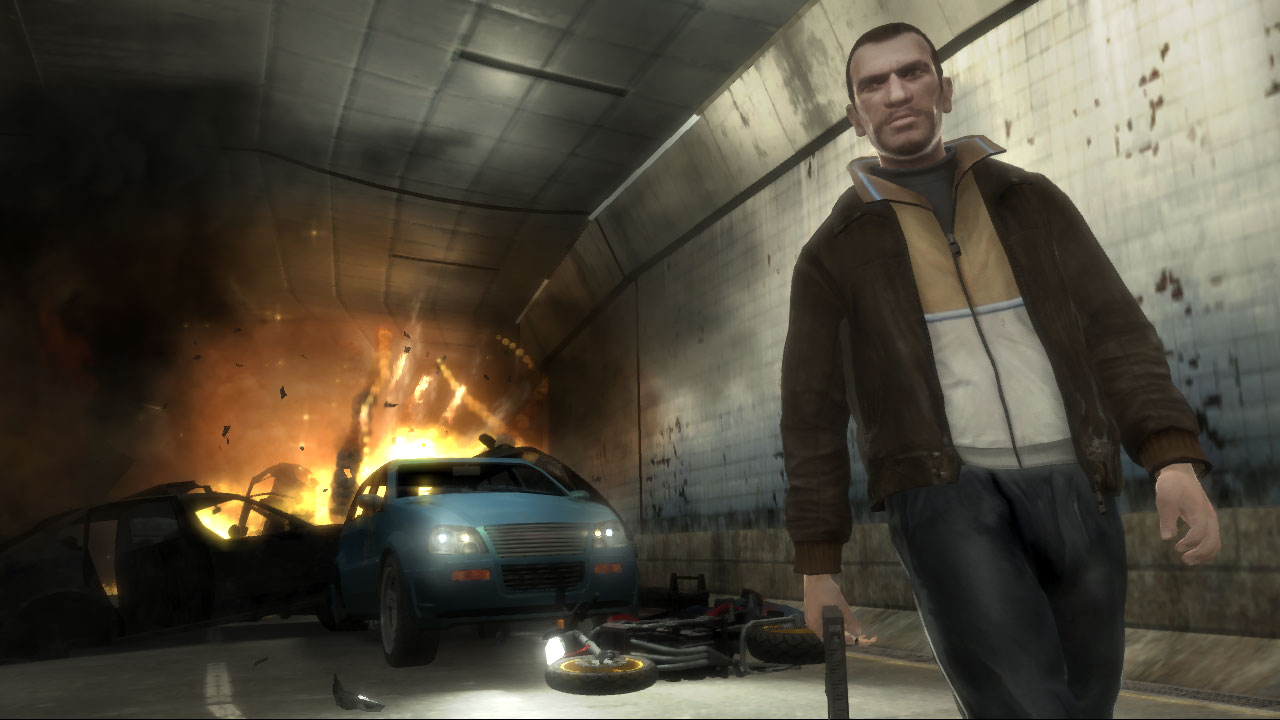
Grand Theft Auto IV was set to be the game that redefined the series once again. Running on Rockstar’s proprietary RAGE engine (Rockstar Advanced Game Engine), and featuring physics powered by NaturalMotion’s Euphoria (which essentially creates a virtual skeletal system for characters within the game world, making for characters that move and react realistically to in-game conditions), GTA4 is easily the best-looking game from Rockstar North to date. The amount of detail within the game environment is awe inspiring, and the both the animation and the physics are astonishing. This is one of the first games I’ve played where it feels like your character has a physical weight and almost a presence within the game. He reacts to everything within the environment, from cars skidding to a stop in front of him to people shouting at him on the streets. It’s really amazing just how much personality was infused into the character simply because of the little details that occur when the player moves through the game world.

GTA4 is the story Niko Bellic, a Bosnian war veteran and illegal Serbian immigrant who comes to Liberty City (a virtual parody of New York City that was also featured, albeit in much different form, in GTA3) to live the American dream, just like his cousin, Roman, says he’s been doing. Unfortunately, Roman’s a liar. Niko finds Roman living in a dumpy apartment on Hove Beach, an area of town that is largely populated by Eastern European immigrants (mirroring New York’s own Brighton Beach, a community on Coney Island), running a taxi service that is, by and large, failing, and, more importantly, in debt to the Russian mafia. To help his cousin out, Niko begins to take on jobs to earn money and pay off Roman’s debt, along the way running into some very unsavory characters.

That set up begins the story of Niko Bellic, by far the most compelling protagonist that Rockstar North has ever created. The story that occurs around Niko is not, however, the massive leap that many claimed. Yes, it’s an engaging story, and yes, it’s emotionally compelling. Yet those things have been done before. GTA4’s biggest downfall is that, while the story is successful in setting Niko up as a sympathetic character, it still allows the player to do what they’ve been doing for seven years with the GTA series, which effectually eliminates any and all character build-up through the player’s own actions. Still, this is necessarily the nature of Grand Theft Auto. Any progression into more artistic and emotional territory would result in a loss of the series’ core fanbase.

That being said, GTA4’s story is an amazing achievement, and one not ordinarily seen in action games. One of the reasons for this is that the major characters seemed to be more fully fleshed out than is the standard for games. Niko, in particular, has a past, a present, and a future; he has friends, he has loves, and he has enemies. It’s because of this, then, that Niko seems to be a more realized character than many seen in role-playing games or in action games of GTA4’s caliber.


Story aside, much of the game is very typical of the Grand Theft Auto series. Missions and story progression often devolve into a very typical formula. Often, players will go to a location, watch a cinematic, go to the next location, watch the next cinematic, and so on, until the mission strand is completed. While this could, plausibly, get old for some players, GTA4 varies things by allowing the player to turn off the story and do what they want for a while. Liberty City is big, and there are a ton of things do and see, from going to a bar (you get drunk) to going to a restaurant, to hitting up a comedy club (comedians Ricky Gervais and Katt Williams provide their own form of inappropriate humor to the game’s proceedings) or a cabaret. Players preferring to stay on a more action-oriented side of things are more than welcome to go and blow up a car, igniting a car chase or shootout that can last for miles, literally.

One of the major improvements to the series is to the game’s interface. With a simple press of the “Up” button on the D-pad, players bring out Niko’s cell phone. The phone is a hub for a large number of story and side missions, as well as having the function to get players online.

Also changed is the map in the game. Yes, there is the typical GTA-style map in the game; that much hasn’t changed. However, the addition of a GPS-like feature in the game—one that is dynamic and changes based on position—nearly changes the dynamic of the game itself. For the most part, the guesswork in navigating is gone. Players need simply to look at their map to get to the next objective on the map. This vastly simplifies matters, but seems to take some of the exploration out of the formula for the game.

Targeting is a major area of improvement from previous games. The player simply needs to squeeze the left trigger completely for auto-aim (which, much like in the hit 2004 game Everything or Nothing, allows for minute adjusting of the aim when in auto-aim), or partway for free-aim. It sounds pretty obnoxious and convoluted, but the fact is that it works better than past games, and that makes it quite the improvement.

Players now also have the ability to take cover behind objects. A simple tap of the right bumper (on 360) places Niko behind cover. This opens up more strategic play for the player. Smarter tactics means fewer unnecessary deaths.

Couple with these the inclusion of the amazing graphics system, which, animation aside, details the smallest of details of Rockstar’s version of New York City, and GTA4 is a very smooth playing game.

Sound is of particular quality in GTA4. Liberty City is a big place, and a good part of the game is spent driving around. No modern GTA would be the same without an amazing soundtrack, and here, GTA4 absolutely doesn’t disappoint. The soundtrack is expansive and covers a myriad of genres, from rap to funk to rock to reggae to talk, and nearly all of the songs represented are good (though there are a few stinkers, but that comes down to personal taste).

Voice acting is equally amazing. Characters are brought to life through their animations and their voices, and all are distinct. Accents are all accurate; so much so that it’s recommended that you turn subtitles on because some characters aren’t exactly understandable.

One of the major appeals of the Grand Theft Auto series is just how free roaming the game play is. This is, for the most part, unchanged in GTA4. However, the story is much more linear. Players actually need to go and change an option, which turns off the story. With that done, players are more or less free to move about the map, without unwanted distractions. If the player decides to not turn off the story mode, they will be continually hounded by other characters, even when not in the middle of a mission.


This is because GTA4 introduces a sort of “relationship” element, which is part dating-sim, part friendship-sim. Throughout the game, the player meets different characters, some of which are added to the in-game cell phone. This opens up a variety of different activities for the player to participate in. Most of them are completely throw away, ranging from a middling pool game to a frustrating bowling game, to less appropriate venues. All of them, however, are either beneficial or detrimental to your in-game relationships. Nurture relationships, from girlfriends to just... friends, and you’ll earn in-game bonuses. Dating one girlfriend for a certain amount of time gives the player a limited ability to drop your wanted level. Another character sells guns out of his trunk, but only after a certain point in the game. Most characters offer some sort of reward for engaging in a relationship of some kind, which adds a very engaging game play element for those willing to explore it.

Apart from that, however, GTA4 is largely the same game that several million people have been playing and enjoying for years. The graphics are improved, the story far more relevant, and there’s a lot more to do in town, but GTA4 is not a game play revolution. It is more an evolution of established concepts, existing ones honed and refined, while new ones introduce new problems to the mix.

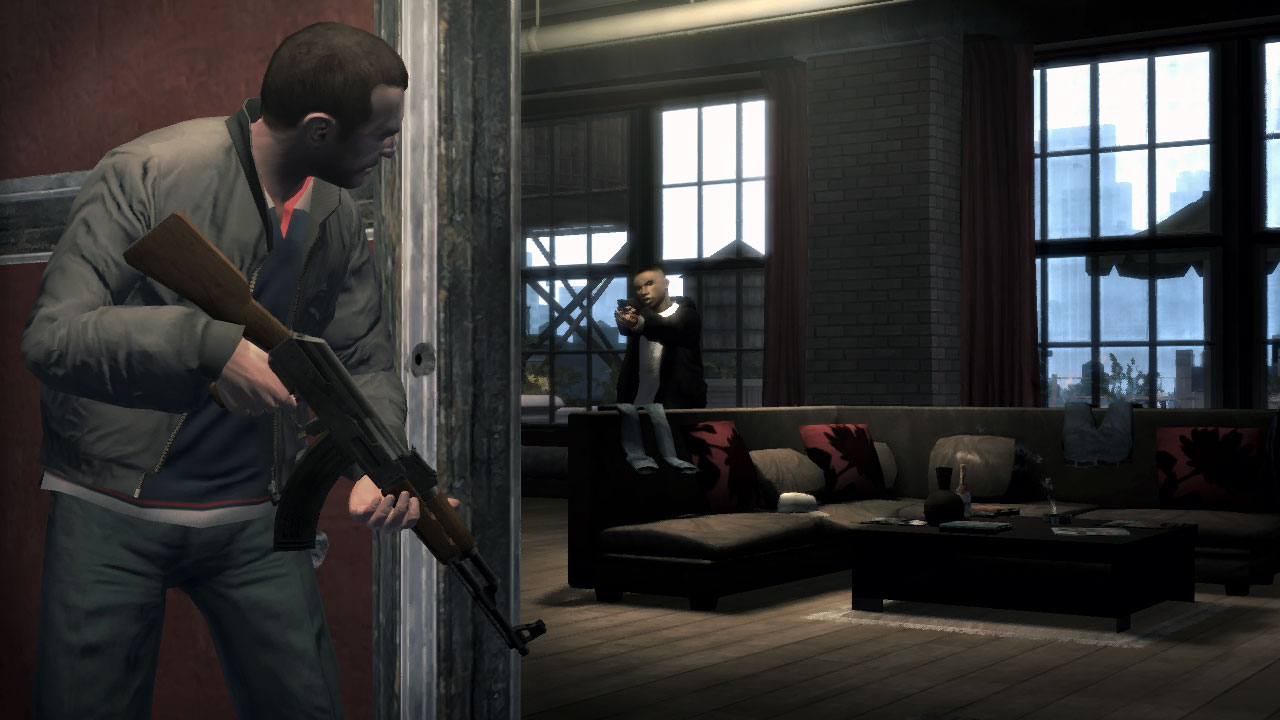
A multitude of problems exist for GTA4 morally, though this is true for every iteration of the franchise. Sex is a thread throughout, with the player having the ability to visit a prostitute or go to a strip club; these are, for the most part, avoidable, though a couple of missions require the player to go to strip clubs. Violence is a major element of game play. Players are thrust into violent and bloody shootouts often, though to their credit, these gunfights are not graphically violent. One mission has the main character pose as a gay man to meet another on a date; another has the player track down a gay basher for a homosexual friend. Profanity is consistently present in GTA4. Characters spew f-bombs, and one says the c-word frequently. Players can date, and have the option of sleeping with their date, though this is not required. If the player does do this, they gain bonuses (discussed above) that enhance game play (read: make it easier). Several situations ask the player to choose to kill or spare a target, while the final act of the game offers revenge as an option, one that is encouraged by a major character.

GTA4 is the culmination of every game of the series up until now. It is violent, offensive, captivating and amusing in equal parts. The satire has not been lost, but has become more refined with each subsequent installment. In fact, one could say that the satire is more biting this time around simply because this is the first GTA in years to take place now, instead of sometime in the past.

This is not the best game in years, nor is it the most inventive. It is, rather, an intriguing exploration of a poignant subject coupled with excellent mechanics and ideas. It is a game of ambition and daring. All of the innovative and rote elements come together here to make a spectacular whole, one that will dazzle all the more if you don’t go in expecting a typical Grand Theft Auto.

--Drew Regensburger (drew@revolve21.com)

Read full article

Wednesday, July 16, 2008

Review - Assassin's Creed

Developer/Publisher: Ubisoft
Release Date: November 2007Available On: Xbox 360, PS3
Genre: Third person stealth shooter
Number of Players: 1
Strong Points: The Parkour/freerunning is incredibly fun and never gets old; some truly outstanding sword duels; some terrific voice acting; gripping plot
Weak Points: Gets repetitive after the first few missions; lead voice actor is a short shot from horrible; ridiculously blatant set up for a sequel; camera angles can sometimes have you trying to see your character through a tree
Technical Score: A-
Artistic Score: B
Final Score (not an average): B
Moral Warnings: Mild language throughout the game including one F-word and a couple uses of "Christ"; some gruesome kills with specific weapons and some particularly bloody cutscenes; the main character has a very nihilistic view on the world


Assassin’s Creed is a third person stealth shooter which places you in the shoes of an assassin trying to reclaim his honor in the year 1191 AD. While the game shines in many areas, repetitive gameplay, replayability issues, and weak lead voice acting, bring out some substantial frowns amidst an experience that could have had us smiling all the way through.

During its development, Assassin’s Creed was said to take place in the year 1191 AD. For those of you that don’t know your history too well, this means during the Crusades that were fought between the Christians and the Muslims. The developers were quite good, however, at keeping its actual time period a secret, which would be that it technically takes place during modern day.

The basic premise is that an evil genius has found a way to go back in time and explore the memories of those long dead; in this case, an assassin from 1191 named Altair. The only way to do this, however, is through the DNA of an ancestor’s distant offspring. This grandson (known as Miles) is connected to a mysterious machine called the Animus, which allows him to control his ancestor like a puppet.

Two storylines branch out in this way, though there is a heavy emphasis on Altair’s plot, with Miles basically only coming out of the Animus to take a potty break and talk with the evil genius. With each assassination, the plot thickens, and the closer the evil genius comes to finding whatever it is he’s looking for inside Altair’s memories.

The ending to the game is a major disappointment and is one of the most blatant setups for a sequel since Halo 2’s ending back in 2004. What’s worse is that the ending is poorly executed and puts a black mark on a story that would otherwise have been excellent.

The gameplay in Assassin’s Creed is built around a simple scheme. At the beginning of each assassination mission you travel to one of the three cities (Jersusalem, Acre, or Damascus) wherein your target is located. Once inside the city, you start an investigation to determine exactly where your target is, when is the best time to strike, etc. You begin this process by climbing to the top of very high buildings/towers (called viewpoints). From the top of these viewpoints Altair can spot a number of different possible tasks that will help him in his investigation.


The tasks that Altair can perform aren’t as varied as they could have been. He can eavesdrop on conversations about his target (and for some reason he always has to be sitting on a nearby bench to do this), pickpocket select persons carrying information, interrogate people, or perform some menial task for a fellow assassin in the city. You also have the opportunity to save various citizens that are being harassed by the guards, which wins you the favor of various scholars and vigilantes who will occasionally help you if you find yourself in some trouble.

This setup, while easy to understand and get the hang of, becomes repetitive after the third or fourth assassination. The process is repeated for every target in every area of every city. Some of these tasks tend to be continually satisfying. Climbing to the top of a viewpoint or taking out guards that are roughing up some poor old lady, while fun, loses its original entertainment value after a while.

Fortunately, the combat and climbing are so entertaining that it makes the repetitiveness almost forgivable... almost.

Altair is always in one of two modes: High Profile or Low Profile. High Profile allows him to perform actions that are more aggressive and socially unacceptable (thus attracting the attention of guards), while Low Profile allows him to perform more stealthy and socially acceptable actions. The change between the two is done with the pull of the Right Trigger. Holding the trigger down brings Altair into High Profile, letting it go brings him into Low Profile. This control scheme, while simple, is incredibly effective and easy to get the hang of. My learning curve was about ten or fifteen minutes.

The system for combat is just as satisfying as free-running across the roof tops. Most of the time you’ll find yourself squaring off against a number of guards, all of whom are intent on putting sharp pieces of metal into your body. Running away is an option, but not always the easiest one. Often, you’ll have to pull out your weapon and bring your game, son. The question is: which weapon will you choose?

After your equipment is returned to you (you’re demoted in the first level), you’ll have four forms of combat to pick from: Altair’s sword, his knife/throwing knives, his fists, or his nasty hidden blade. The combat system works the same for all the weapons save for Altair’s fists. The best way to take out enemies is by performing a counter move that must be timed when an opponent begins his strike. These counter attacks can be somewhat tricky to perform, especially later on in the game, but the result is worth it. The sword and the knife operate the same, though using the knife allows Altair the option of throwing his small knives at far away opponents and provides for some rather nasty killing animations. The fists are somewhat of a disappointment, as I expected an assassin to be somewhat gifted in hand to hand combat. The only time that his fists are really used is when interrogating some unfortunate soul for information. In battle against guards, they are nearly useless. Finally, he can use his hidden blade. The blade is used mostly for stealth kills and for taking out your assassination targets. I was surprised to find out that you can also use it in combat, though doing so is quite risky as you have nothing to defend yourself with. Performing a counter attack with it is, however, always fatal.

One issue I had with the combat was the camera angles. The camera set up for the combat is actually quite good. The view will elevate when Altair zooms in the target, giving you a better look at what your opponent is going to do and is also very helpful when fighting against multiple targets. The only problem is that occasionally trees or poles or other various objects get in the way and obstruct the view. This doesn’t happen often, but it’s still an issue. Also, a strange thing happened to me on the last level where Altair actually fell through the map (apparently, other gamers have had this issue as well). Another time the game slowed done, but after I died everything went back to normal and was fine. Other than those select instances, it runs very smoothly.

Moving onto graphics, Assassin’s Creed looks beautiful. The cities themselves are the best looking that I’ve ever seen in a video game, wonderfully constructed and (even cooler) historically accurate as well. One of the most entertaining things is climbing up high to a view point and gazing at the incredibly expansive borders of Acre, Jerusalem, and Damascus. Aside from being beautiful, the cities are huge. At the end of the game, when certain districts of the city aren’t cut off to you anymore, you’ll feel like there’s no place you can’t go. Which is mostly true.

The citizens that make up these cities look decent which is a fairly impressive feat in itself when you consider just how many citizens there are. There are a wide variety of player models for the lovely innocent bystanders, but even so, you’ll often come across two people walking side by side who you’ll swear are twins. They all walk smoothly enough, and they all run well when they panic after seeing that one dead guard that an unknown assassin killed.

Altair looks absolutely gorgeous (speaking graphically, of course). His movements are all graceful, whether he’s doing something as simple as walking through the crowd or free running across the roof tops to escape angry guards. The fluidity of the motions make you believe that it’s actually possible to do some of the amazing acrobatics that Altair performs.

As for the sound of the game, Ubisoft has always been good with this element and there’s no exception here. In fact, the sound is what makes the cities of Jerusalem, Acre, and Damascus, so lifelike. People shout at you from the market to buy their goods, the beggars plead for a morsel of food, and the guards quickly reprimand you if you get in their way.

The voice acting is some of the best I’ve heard in a video game, helping to add to the list of recent popular games that set the bar high for that area. Surprisingly, the one character that is poorly acted out is Altair himself. The assassin’s lines are delivered in the same fashion throughout the whole game, barely changing emotion, often speaking in a boring monotone and never allowing us to get a strong feel for his character. The developers are lucky that the rest of their voice cast is so good, because Altair’s acting had serious potential to be a thorn in every gamer’s side. Fortunately, the rest of the sound is done so well that it becomes more of a pebble in your shoe that only bugs you every now and then.

The sounds during battle are equally impressive. The swords clang loudly when they connect, arrows hiss as they whiz by Altair’s head, and there’s the sickening, but realistic, noise when Altair’s blade strikes its intended target. All add to a very intense and already impressive combat experience.

The soundtrack for the game is subtle but well done; pretty much what you can expect from a modern video game. The music is pretty and quiet in the background when walking through the streets, fast paced and heart pounding when Altair is fleeing from the scene of one of his kills. All in all, a good soundtrack.

Assassin’s Creed is rated “M” for Blood, Strong Language, and Violence. Ubisoft milked that rating for all it’s worth. It’s one of the few video games that actually made me compare it to an “R” rated movie (in this case it would be the Director’s Cut of Kingdom of Heaven).

First off is the obvious premise of being an assassin. Your job is to kill another human being, and if you do your job well, you will kill that human being when he is defenseless and not expecting you to strike; in other words, cold blood. The people that you kill are all evil in their own way, but then again, Altair isn’t exactly the pope, either. The first thing that surprised me in the game was the amount of blood that will burst from a body when you strike it with your weapon. Strangely enough, while it shoots out thick, it seems to evaporate in mid-air, as blood never stains the ground nor gets on anyone’s clothing. This is good for Altair, as he is always wearing white. On a positive note, the blood can be turned off. The gruesome deaths, however, cannot be. These come in hoards when Altair wields his knife. After performing a combo move or a counter attack, he gets in close and strikes at the enemy’s vitals. He will slash throats, stab the heart repeatedly, or use his free hand to snap the neck. His hidden blade is somewhat nasty as well, as it is used to go into the neck. The animations for when he fights with the hidden blade are gruesome as well, and the first thing that popped in my mind when I used the hidden blade in combat for the first time was, “Gee... what a terrible way to die.”

Assassin’s Creed is fairly deserving of a Strong Language warning, but it’s not nearly as heavy handed as the violence is. You hear almost all of the minor swear words during the game; b------ is used fairly frequently, and the F-word is used once.

Some theological issues come into play as well. At the beginning of the game, Altair is fond of the saying, “Nothing is true; everything is permitted.” This worldview is often reinforced by the ones that Altair assassinates, claiming that the bad and often cruel things that they have done were for the good of the people. Their words are crafty, and make Altair wonder if they speak truth. At the end, he decides that his slogan at the beginning of his journey is wrong, but the worldview is still present. At the end of Assassin’s Creed, there is a cut-scene where many of the events from the Bible are labeled as nothing more than illusions. It should be noted that the one who claims this is the antagonist in the story - your stereotypical power-crazy bad guy.

Ultimately, Assassin's Creed is good, but not as good as it wants to be. It has many things going for it, but not quite enough to negate the effects of its flaws and take it to that next level of gaming.

-Zak Mellgren (zak@revolve21.com)

Read full article